

 อังกฤษ


 บ้าน / ข่าว / ข่าวอุตสาหกรรม / การปิดผนึกที่แม่นยำ: การควบคุมความหนาแน่นของการบรรจุต่อมกราไฟท์บริสุทธิ์และการปฏิบัติตามข้อกำหนดการปล่อยก๊าซต่ำ
 การปิดผนึกที่แม่นยำ: การควบคุมความหนาแน่นของการบรรจุต่อมกราไฟท์บริสุทธิ์และการปฏิบัติตามข้อกำหนดการปล่อยก๊าซต่ำ
 2025.12.04
 ข่าวอุตสาหกรรม
In critical industrial applications—from power generation to petrochemical processing—the performance of pure graphite gland packing is measured by its ability to reliably contain media across extreme thermal and pressure cycles. For engineers and B2B buyers, the key technical determinant of sealing effectiveness is density. Mastering Pure graphite gland packing density control is the foundation for meeting the industry's most stringent low-leakage standards, such as API 622 and ISO 15848.
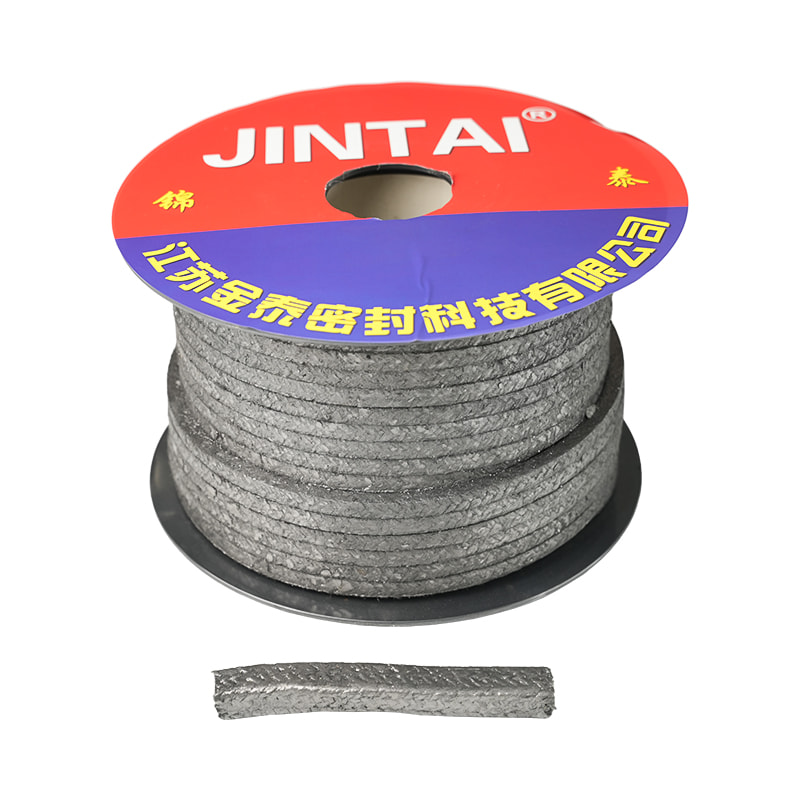
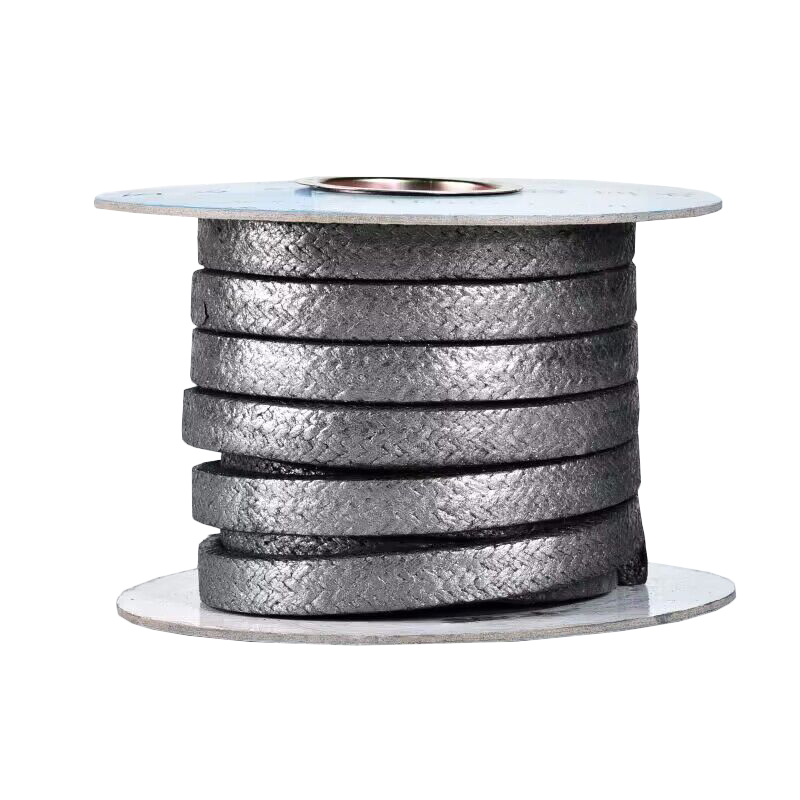
Pure Graphite Braided Gland Packing For Valves Pupm
The Fundamental Link: Graphite Packing Density vs Leakage Rate
Density in sealing is directly proportional to performance. A higher density means fewer internal voids and microscopic leak paths, which dramatically improves sealing integrity. Understanding the relationship between Graphite packing density vs leakage rate is essential for procurement.
Defining Density Targets for High-Integrity Sealing
- **Lower Density Issues:** If the packing density is too low (e.g., poorly compressed or manufactured), the material acts more like a porous barrier than a seal. This permits high fugitive emissions, especially under pressure.
- **Higher Density Benefits:** Increasing the density enhances the radial pressure transfer against the stem or bore, effectively shutting down microscopic leak paths and reducing the overall permeability of the seal mass.
Manufacturing Techniques for Precise Pure Graphite Gland Packing Density Control
Precise density control is achieved through controlled processes like die-forming or specific braiding patterns. The goal is to achieve maximal compaction without compromising the graphite's inherent flexibility, which is necessary for proper gland compression.
Density Requirement Comparison Table (Typical Values)
| Application Type | Required Density (g/cm³) | Expected Sealing Performance |
|---|---|---|
| General Industrial Sealing (Low Pressure) | 1.0 - 1.2 g/cm³ | Acceptable leakage for non-critical services. |
| High-Pressure Steam/Heat Exchangers | 1.3 - 1.45 g/cm³ | Required for maintaining structural stability under high stress. |
| Low-Emission Valve Service (API 622) | 1.5 g/cm³ or Higher (Crucial for Pure graphite gland packing density control ) | Essential for achieving the ultra-low emissions required by modern standards. |
Meeting Standards: Achieving Low Emission Graphite Packing API 622 and ISO 15848
The industry benchmark for environmental compliance in valve sealing is dictated by fugitive emission standards. High-density **pure graphite gland packing** is the preferred material for meeting these stringent requirements.
API 622 Testing Protocols and Fugitive Emissions Thresholds
- **Testing Rigor:** API 622 involves rigorous thermal and pressure cycling of the valve stem. Compliance requires the packing material to demonstrate a leakage rate below a threshold (e.g., 100 parts per million volume, or ppmv) for a minimum number of mechanical cycles.
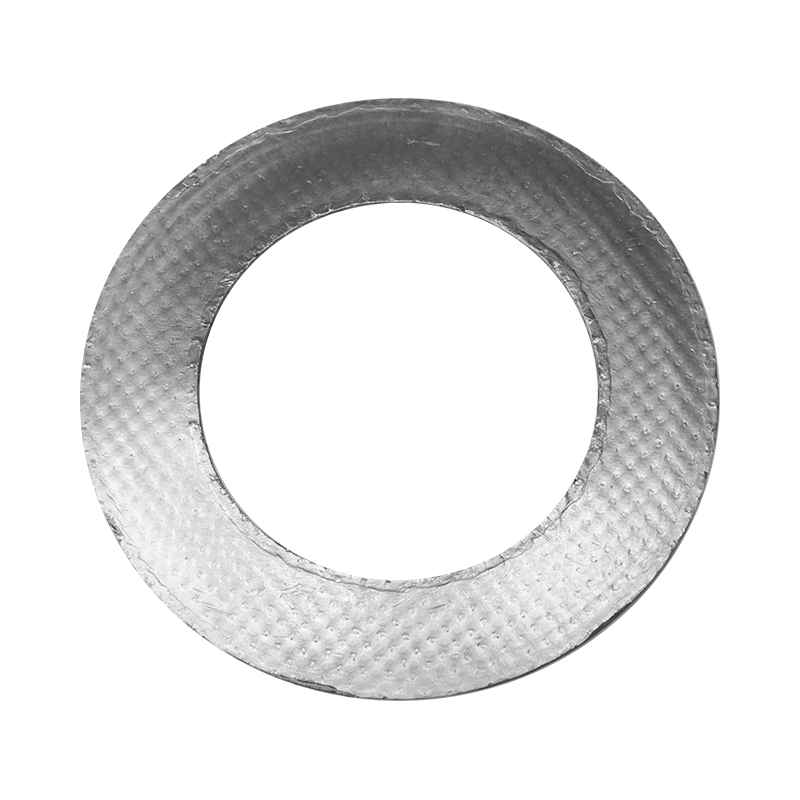
- **Density Impact:** Only packing optimized for high-density, typically supplied in die-formed rings, can consistently achieve the sealing force necessary to maintain the fugitive emission performance required by Low emission graphite packing API 622 over thousands of cycles.
Design Optimization: The Role of Braiding and Die-Formed Rings
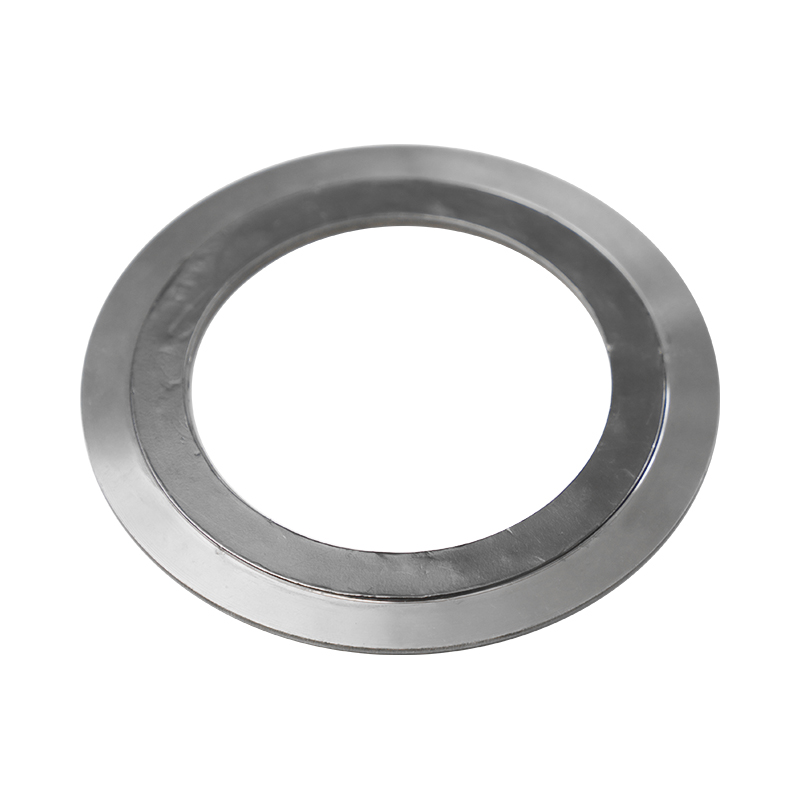
While braided packing offers versatility, die-formed rings provide superior density control and homogeneity, which is paramount for Low emission graphite packing API 622 compliance. Die-formed rings ensure the density profile is uniform throughout the entire ring cross-section, maximizing the effectiveness of the sealing stack.
Application Engineering: Flexible Graphite Packing for Valve Stems Technical Considerations
When using Flexible graphite packing for valve stems , the sealing force must be balanced against operational factors, particularly stem friction.
Impact of Packing Density on Stem Torque
- **Torque Increase:** Excessive density, achieved through over-compression, can drastically increase the friction (torque) required to operate the valve stem. This excess friction leads to increased actuator wear, higher power consumption, and potential binding.
- **Optimization:** The ideal density specified in the Technical specifications for pure graphite packing is a precise balance: high enough to meet the low-leakage target, but not so high as to cause excessive operating torque.
Integrating Technical specifications for pure graphite packing into Procurement
Procurement documents should specify not only the material composition but also key Technical specifications for pure graphite packing such as the target density range, the maximum acceptable API 622 leakage rate, and the required operational temperature/pressure limits. This technical detailing ensures that the supplied **pure graphite gland packing** is fit for critical service.
Jiangsu Jintai Sealing Technology Co., Ltd.: Driving Sealing Innovation
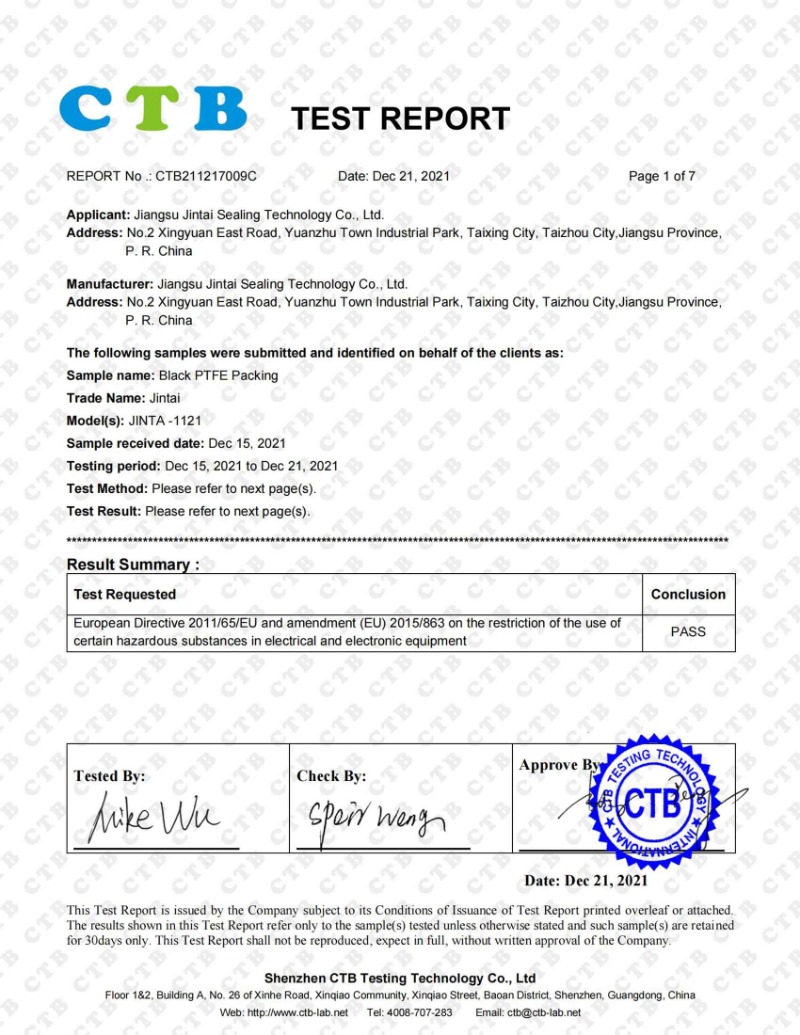
Jiangsu Jintai Sealing Technology Co., Ltd., founded in 2004, is a large comprehensive sealing technology enterprise specializing in research, manufacturing, and selling various types of seals. Our high-end sealing product brand, Nofstein, focuses on high-quality sealing solutions for numerous industries including power, chemistry, and shipping. We understand that performance hinges on precision, especially regarding **pure graphite gland packing**. We continually carry out technological innovation, adopting advanced manufacturing processes to achieve meticulous Pure graphite gland packing density control . Our commitment to quality, evidenced by certifications like the CCS classification society identification and participation in major projects, ensures our products meet the stringent low leakage requirements for Low emission graphite packing API 622 , enabling us to undertake various major projects and serve global partners.
Frequently Asked Questions (FAQ)
1. What is the fundamental relationship between Graphite packing density vs leakage rate ?
There is an inverse relationship: as the density of the graphite packing increases (within the optimal range), the volume of internal micro-voids decreases, leading directly to a lower fluid leakage rate.
2. Why are die-formed rings often preferred over braided Flexible graphite packing for valve stems for low-emission applications?
Die-formed rings offer superior density uniformity and homogeneity compared to braided forms, which is crucial for achieving the high sealing integrity necessary to meet the demanding thresholds of Low emission graphite packing API 622 standards.
3. What is the goal of Pure graphite gland packing density control in terms of stem operation?
The goal is a precise balance: the density must be high enough to minimize leakage, but not so high that it generates excessive friction (torque) on the valve stem, which would accelerate actuator wear.
4. What specific performance metrics should be included in the Technical specifications for pure graphite packing for critical service?
Specifications should include the required density range (g/cm³), carbon purity percentage (e.g., 99.5% minimum), the maximum allowable API 622 leakage rate (ppmv), and dimensional tolerances.
5. What does the API 622 standard primarily test regarding graphite packing?
API 622 tests the packing's fugitive emission performance by subjecting it to repeated thermal and mechanical cycling (stem movement) under pressure. The seal must maintain leakage below a defined parts per million volume (ppmv) threshold.

 บ้าน
บ้าน
เกี่ยวกับเรา
ข่าว
 +86 152 4020 4398
 No.2 Xingyuan East Road, สวนอุตสาหกรรมเมือง Yuanzhu, เมือง Taixing, มณฑลเจียงซู, จีน
Copyright © 2024. Jiangsu Jintai Sealing Technology Co. , Ltd. All rights reserved. ปะเก็นซีลแบบกำหนดเอง, บรรจุภัณฑ์ซีล, ผลิตภัณฑ์ยาง
